
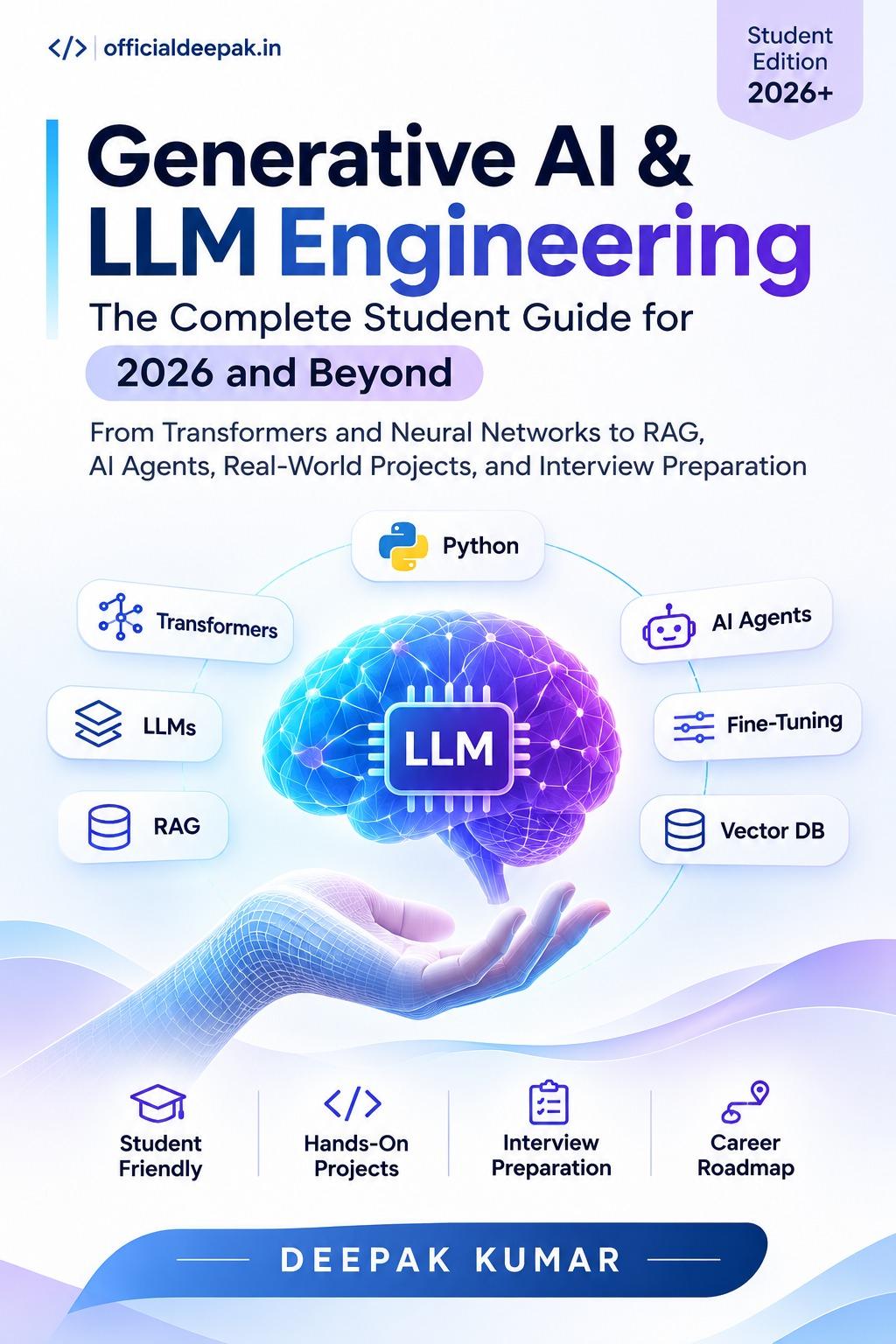
Generative AI & LLM Engineering: The Complete Student Guide for 2026 and Beyond
From Transformers and Neural Networks to RAG, AI Agents, Real-World Projects, and Interview Preparation
- Length
- 138 pages
- Chapters
- 16 chapters
- Words
- 48,595 words
- Level
- mixed
- Price
₹1,950Free- Readers
- 0 readers
Generative AI is transforming software development and the technology industry. But using AI tools is only the beginning. To become an AI engineer, you need to understand how these systems work and how to build practical applications with them.
This book provides a structured learning path for students, fresh graduates, software developers, and aspiring AI engineers who want to learn Generative AI from the fundamentals to real-world implementation.
Understand How Modern AI Works
Start with the foundations of Artificial Intelligence, Machine Learning, Deep Learning, and Neural Networks. Discover how generative models create text, images, and other content.
Explore Large Language Models (LLMs), tokens, tokenization, embeddings, context windows, model parameters, and next-token prediction.
Understand Transformer architecture, self-attention, positional encoding, and encoder-decoder structures. Learn how models are trained through pretraining, fine-tuning, and alignment. Explore inference, quantization, and the differences between open-weight and hosted models.
Build Real-World AI Applications
Move beyond theory and start building with Python and modern AI development tools.
Learn prompt engineering, structured outputs, model APIs, embeddings, semantic search, and vector databases. Build Retrieval-Augmented Generation (RAG) applications that answer questions using your own documents and data.
Explore advanced RAG, document processing, retrieval evaluation, reranking, and techniques for reducing hallucinations. Understand fine-tuning fundamentals, open-weight models, and local inference.
Go further with AI agents, tool calling, multi-step workflows, memory, and the Model Context Protocol (MCP). Learn to evaluate AI applications while considering security, privacy, latency, cost, and responsible AI.
Prepare for AI Engineering Interviews
Prepare with technical questions, scenario-based problems, Python exercises, architecture discussions, and project walkthroughs.
Learn to explain how Transformers work, compare RAG with fine-tuning, troubleshoot retrieval problems, evaluate model quality, reduce inference costs, and design reliable LLM-powered applications.
The focus is on understanding concepts and solving problems, not simply memorising answers.
Who Is This Book For?
- Computer science and engineering students
- Final-year students and fresh graduates
- Python and full-stack developers
- Software engineers exploring Generative AI
- Aspiring Machine Learning and LLM engineers
- Professionals transitioning into AI engineering
Basic programming knowledge is helpful. Python is used for practical examples, and concepts are introduced progressively. No previous knowledge of Transformers or LLMs is required.
What Will You Learn?
By the end of this book, you will be able to:
- Explain Generative AI and LLM fundamentals.
- Understand Transformers, attention, tokens, and embeddings.
- Work with LLM APIs and open-weight models.
- Build semantic search and RAG applications.
- Understand AI agents and tool-calling workflows.
- Evaluate AI outputs and identify common limitations.
- Develop practical projects for your portfolio.
- Prepare for Generative AI engineering interviews.
About the Author
Deepak Kumar is a software engineer with more than seven years of experience in software development, including frontend engineering, backend development, application architecture, and production systems. His technical interests include Generative AI, Large Language Models, and practical AI application development.
Through this book, he aims to make complex technical concepts approachable and connect foundational knowledge with real-world engineering practices.
Learn the fundamentals. Build practical AI applications. Understand the technology. Prepare for the future of software engineering.
What you will be able to do after reading it
- Explain the differences between AI, machine learning, deep learning, and Generative AI.
- Explain tokens, embeddings, attention, and Transformer architecture.
- Describe LLM pretraining, fine-tuning, inference, and model limitations.
- Write Python applications using LLM APIs and open-weight models.
- Design effective prompts and validate structured model outputs.
- Build semantic search and RAG applications with document retrieval.
- Implement tool calling and basic AI agent workflows.
- Evaluate hallucinations, retrieval quality, latency, and model costs.
- Apply security, privacy, and responsible AI principles.
- Build portfolio projects and explain their architecture in interviews.
- Answer LLM engineering interview questions with practical reasoning.
Who this book is for
Computer science students, final-year engineering students, fresh graduates, Python developers, full-stack engineers, and software professionals with 0–3 years of AI experience who want to become Generative AI or LLM engineers.
Assumed knowledge: Basic programming concepts, variables, functions, loops, data structures, and basic command-line usage. Python is helpful but core AI concepts are introduced from the beginning. No prior Transformer or LLM knowledge is assumed.
Read it now — free, no signup
The whole book is on this site. Start at chapter one, or jump to whichever chapter you came for.
138 pages · 16 chapters · no paywall, no signup to read
Keep a copy of all 138 pages
The book is free to read above — this is for the printable single-file copy. One email with the link, and occasional notes when there is a new book. No other mail, and one-click unsubscribe in every message.
By tapping Send me Generative AI & LLM Engineering: The Complete Student Guide for 2026 and Beyond, you agree to the Privacy Policy. Your name, email and number are used only to send this book and, until you unsubscribe, emails about new books. Never sold or shared.
Read the opening
A study assistant can give a polished answer, cite a real PDF, and still attribute a claim to a page that does not support it. The interface looks finished. The engineering is not.
That gap is why I wrote this book. A successful model call proves that your credentials and network connection work; it does not prove that your application deserves anyone's trust. I want you to learn how to separate those claims, build tests for them, and explain what remains uncertain.
My background spans frontend engineering, backend systems, application architecture, and production software. That shapes my priorities here: explicit contracts, visible failures, and decisions you can defend. I would start with a small evaluation set before adding an agent framework. A framework can organize execution; it cannot decide whether your assistant retrieved the wrong paragraph.
Free documentation is usually the right place to check an API signature. It is less helpful when you do not yet know whether your problem belongs in document extraction, retrieval, prompting, or model adaptation. This book supplies that sequence through one project, an assistant built around permitted course materials.
Put this book down if you want a catalogue of prompt tricks, a guarantee of employment, or instructions for training a frontier model from scratch. It is also not a research monograph for readers already comfortable deriving attention and designing training objectives. You need basic programming knowledge and the patience to inspect failures, not prior LLM experience.
The title's promise of completeness has a boundary: a connected engineering foundation, not every paper or product. Libraries will change. When they do, can you identify which assumption broke?
Your assistant answers a question correctly once. Then you replace the PDF, change the model, or ask the same question differently, and the answer becomes unreliable. Without separate checks for extraction, retrieval, and generation, every proposed fix becomes a guess. A longer prompt may hide the defect rather than remove it.
The project in this book makes those boundaries inspectable. You will build a study assistant that reads permitted course notes, retrieves passages with their sources, and generates answers that can be checked against those passages. Later, it handles additional media and calls tools under application-controlled limits. Retrieval-augmented generation, or RAG, is the part that supplies retrieved evidence to the model; it is not a guarantee that the model will use that evidence correctly.
The chapters that carry the structure
Read Chapter 1 before writing application code. Its testable project scope gives the later experiments something to answer to. Chapters 2–5 establish the mechanics: a small neural network, generative objectives, attention, and the differences between pretraining and subsequent alignment. If vectors, gradients, and tensor shapes are already familiar, you can skim Chapter 2, but check that you can explain the worked operations without relying on their names.
Chapters 6, 8, 9, and 10 are the application spine: reliable model calls, document preparation, evidence assembly, and diagnostic evaluation. Do not skip Chapter 8 because you already know a vector database. Lost page numbers and broken text extraction cannot be repaired by a better similarity index. Read Chapter 13 before Chapter 14; tool authorization belongs in application code, not in a request that the model promise to behave. Chapter 15 is essential before deployment, and Chapter 16 turns the project's evidence into interview material.
Chapter 7's local inference work can wait if you are following the API route. Chapters 11 and 12 are optional on a first pass through a text-only assistant: fine-tuning and multimodal input add distinct costs and failure modes. I would defer both until the evaluation suite identifies a reason to add them. Do not mistake an optional experiment for a required architectural component.
Prepare a modest development environment
I recommend Python 3.11, a virtual environment, pip, a code editor, and Git. Install PyTorch for the neural-network exercises and Hugging Face Transformers for the open-weight model work, following the relevant chapter's dependency instructions. Keep API credentials outside source control. Live API exercises require an account, network access, and a spending limit you are prepared to enforce. A GPU is not a prerequisite for starting; check memory requirements before attempting local inference or adaptation.
Bring a small collection of notes you own or have permission to process. Begin with text-based PDFs rather than scans. Keep held-out questions and expected supporting passages separate from prompt-development examples. For each experiment, record the model identifier, settings, inputs, and observed results. When an answer fails, which stage can your records actually rule out?
What is inside — all 16 chapters
- 1
Start with a Testable Study Assistant, Not an AI Demo
I distinguish AI, machine learning, deep learning, and generative AI, then turn the study assistant into a small, testable software project. The book's argument starts here: useful AI engineering means defining acceptable behavior before choosing a model.
- 2
Learn the Mathematics by Training One Small Neural Network
I introduce only the mathematics needed to inspect and train a small network: vectors, matrices, probability, derivatives, and optimization. A runnable PyTorch experiment makes learning visible while exposing overfitting and the cost of unnecessary complexity.
- 3
Generation Is a Distribution, Not a Database Lookup
I compare autoregressive models, variational autoencoders, generative adversarial networks, and diffusion through their objectives and sampling mechanisms. The practical focus then narrows to tokenization, embeddings, and a tiny next-token model so that later LLM behavior has a concrete explanation.
- 4
Build Attention Before You Trust a Transformer Diagram
I construct the Transformer from attention operations upward, keeping tensor shapes and information flow explicit. The original encoder-decoder architecture is distinguished from encoder-only and decoder-only designs rather than treating every Transformer as the same model.
- 5
Pretraining Teaches Patterns; Alignment Does Not Guarantee Truth
I separate pretraining, instruction tuning, and preference optimization by their data, objectives, and limitations. BERT, GPT-3, and InstructGPT provide historical evidence without turning their published results into promises about current models.
- 6
Make the First LLM Call a Reliable Python Component
I connect the study assistant to a model API, then make prompts and validated outputs part of an explicit application contract. Live calls have documented credentials and costs, while deterministic fixtures keep the runnable examples testable without an account.
- 7
Run Open-Weight Models Without Assuming Local Means Cheap
I use the Hugging Face Hub and Transformers to run a small open-weight model and compare it with the API-backed assistant. Model licenses, memory estimates, quantization, and chat templates make the comparison an engineering decision rather than a leaderboard contest.
- 8
Retrieval Starts with Documents, Not a Vector Database
I turn permitted course notes and text-based PDFs into a searchable collection while preserving page-level provenance. The chapter separates extraction, chunking, sentence embeddings, and indexing so that readers can identify which stage damaged an answer's evidence.
- 9
Build RAG as an Evidence Pipeline, Not a Longer Prompt
I connect retrieval to generation and make source selection, context assembly, citations, and abstention observable parts of the study assistant. The original Retrieval-Augmented Generation paper is distinguished from the application-level retrieve-then-generate pipeline built here.
- 10
Fix the Failing Stage Before Buying a Bigger Model
I build a diagnostic evaluation suite for retrieval and grounded answers, then introduce hybrid retrieval and reranking only where measured failures justify them. Missing passages, misleading citations, and confident unsupported answers become reproducible engineering problems rather than vague complaints.
- 11
Fine-Tune Behavior Only After Proving Retrieval Is Not the Fix
I use the existing evaluation suite to decide whether adaptation is justified before allocating training resources. A small LoRA experiment teaches dataset construction, parameter-efficient fine-tuning, and regression checks; QLoRA is explained with explicit hardware requirements rather than universal runnability claims.
- 12
Add Images and Lectures Without Losing the Source Trail
I extend the same study assistant to scanned pages, diagrams, recorded audio, and short video excerpts. The emphasis is on modality-specific uncertainty and provenance, not on pretending that every multimodal model handles every input equally well.
- 13
Treat Retrieved Text as Untrusted Before Giving the Assistant Tools
I threat-model the assistant before it can take actions, separating model instructions from authorization and application policy. Security, privacy, and responsible use become executable checks, with explicit limits on what filtering and model refusals can guarantee.
- 14
Give the Assistant Tools, Not Unlimited Autonomy
I add validated tool calls and a bounded agent loop only after the assistant has evaluation and security controls. Model Context Protocol is introduced as an integration protocol, not a substitute for authorization, planning quality, or application-owned safeguards.
- 15
Ship the Assistant Without Hiding Its Operating Costs
I turn the evaluated assistant into a deployable service and make release decisions depend on observable behavior. A documented external LLM application case study is clearly labeled as external; reported measurements require traceable sources, while the book's own measurements come only from reproducible runs.
- 16
Turn the Study Assistant into Evidence You Can Defend in an Interview
I consolidate the chapter exercises into a portfolio whose claims are backed by runnable code, test data, and measured trade-offs. Interview questions use worked model answers and follow-up challenges to test reasoning, while the career roadmap identifies practical next steps without promising employment.
Questions
- Is Generative AI & LLM Engineering: The Complete Student Guide for 2026 and Beyond free?
- Yes. All 16 chapters — 138 pages — are free to read online with no signup and no paywall. An email address is only needed if you want the whole book as one printable file to keep.
- Do I need to sign up to read Generative AI & LLM Engineering: The Complete Student Guide for 2026 and Beyond?
- No. Every chapter is a public page you can read immediately. Signing up is optional and only gets you the single-file, printable copy.
- Who is Generative AI & LLM Engineering: The Complete Student Guide for 2026 and Beyond for?
- Computer science students, final-year engineering students, fresh graduates, Python developers, full-stack engineers, and software professionals with 0–3 years of AI experience who want to become Generative AI or LLM engineers. It assumes you already know: Basic programming concepts, variables, functions, loops, data structures, and basic command-line usage. Python is helpful but core AI concepts are introduced from the beginning. No prior Transformer or LLM knowledge is assumed.
- What will I learn from Generative AI & LLM Engineering: The Complete Student Guide for 2026 and Beyond?
- After reading it you will be able to explain the differences between AI, machine learning, deep learning, and Generative AI.; explain tokens, embeddings, attention, and Transformer architecture.; describe LLM pretraining, fine-tuning, inference, and model limitations.; write Python applications using LLM APIs and open-weight models.; design effective prompts and validate structured model outputs.; build semantic search and RAG applications with document retrieval.; implement tool calling and basic AI agent workflows.; evaluate hallucinations, retrieval quality, latency, and model costs.; apply security, privacy, and responsible AI principles.; build portfolio projects and explain their architecture in interviews.; answer LLM engineering interview questions with practical reasoning..
- How long is Generative AI & LLM Engineering: The Complete Student Guide for 2026 and Beyond?
- 16 chapters, about 48,595 words — roughly 138 printed pages.
- Does it include code examples?
- Yes — the examples are in python, and every snippet is checked by a parser before publication so it runs as written.
- Was this book written with AI?
- Yes. Generative AI & LLM Engineering: The Complete Student Guide for 2026 and Beyond was drafted by an AI writing pipeline and then reviewed and edited by Deepak Kumar before publication. Every code example is verified automatically, and chapters that did not meet the editorial bar were rewritten or held back. We say so plainly rather than leaving you to work it out.
- What happens to my email address?
- It is used to send you the book and occasional notes when there is a new one. It is never sold or shared, and every email has one-click unsubscribe.