
Next.js Advanced Engineering · typescript · Advanced
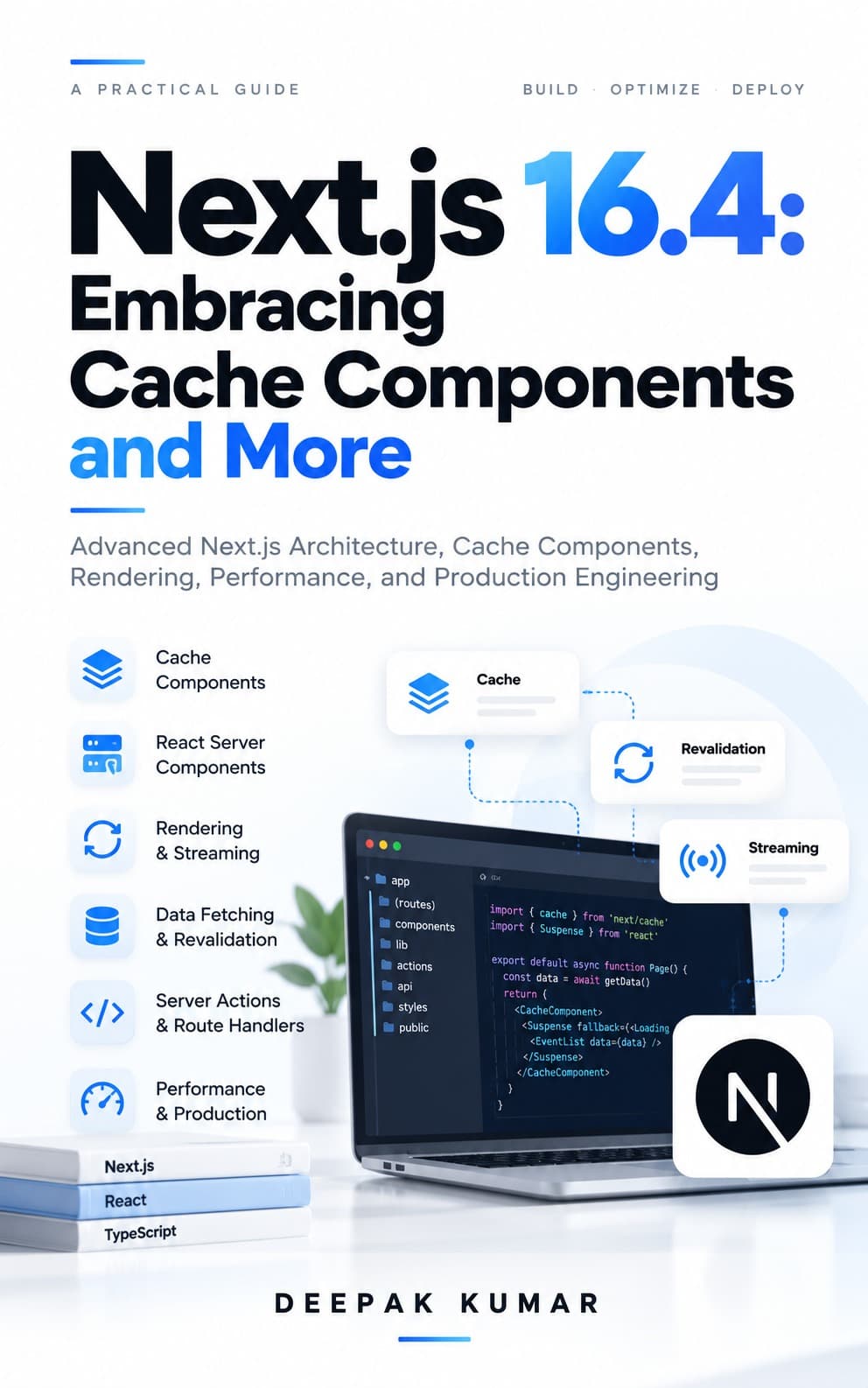
Next.js 16.4: Embracing Cache Components and More
Advanced Next.js Architecture, Cache Components, Rendering, Performance, and Production Engineering
An Advanced Guide to Rendering, Caching, Performance, and Production Engineering. Building modern web applications requires more than writing components and connecting APIs. Developers must understand how rendering, data fetching, caching, and server-side execution work together to deliver fast, secure, and reliable experiences. This book is a practical guide for developers who want to understand the engineering behind production-ready Next.js applications. Explore the App Router, React Server Components, Client Components, Cache Components, prerendering, request-time rendering, streaming, Suspense, and data fetching. Understand how rendering strategies influence performance and how to select the right approach for different application requirements. A central focus is Cache Components and caching architecture. Learn how cached and uncached data behave, how rendering boundaries affect reuse, and how invalidation and revalidation help maintain data freshness. Investigate stale responses, unnecessary requests, and unexpected rendering behavior. Key topics include: Rendering: App Router, Server Components, Client Components, and streaming.; Caching: Data fetching, invalidation, revalidation, and data freshness.; Full-stack development: Server Actions, Route Handlers, databases, and validation.; Security: Authentication, authorization, and protecting sensitive data.; Performance: Core Web Vitals, image optimization, profiling, and measurement.; Technical SEO: Metadata, canonical URLs, and structured data.; Testing and debugging: Diagnosing failures and validating application behavior.; Production engineering: Configuration, deployment, logging, and monitoring. A production-oriented application connects concepts throughout the book. Follow the request lifecycle from data access through rendering, caching, and response delivery. Practical examples demonstrate implementation patterns, common failures, debugging techniques, and architectural trade-offs. Learn to investigate framework behavior, measure performance, evaluate alternatives, and write maintainable TypeScript. Version-specific features are distinguished from general React principles, with technical claims grounded in documentation and reproducible examples. Designed for experienced React developers, Next.js engineers, full-stack JavaScript developers, and technical leads, this book assumes familiarity with components, hooks, asynchronous programming, and the Next.js App Router. It is particularly useful for developers who want to diagnose caching problems, improve rendering performance, separate server and client responsibilities, and make informed production architecture decisions. Deepak Kumar is a software engineer with more than seven years of experience across frontend engineering, backend services, application architecture, and production systems. His technical interests include React, Next.js, Node.js, database-driven applications, and performance optimization. Through his writing, Deepak aims to connect technical documentation with practical engineering decisions, emphasizing systematic debugging, maintainable code, and reliable software. Develop a stronger understanding of Next.js rendering and caching, diagnose data freshness and performance problems, and make informed decisions when designing secure, scalable applications. The goal is not simply to use Next.js APIs. It is to understand the system, choose the right approach, and build production software with confidence.
What you will learn
- Design scalable Next.js App Router architectures
- Explain Server Components and Client Components boundaries
- Implement Cache Components using version-appropriate APIs